

Landlord Scam Files

The Landlord Scam:
Documented Timeline of Legal Proceedings and Events
Disclaimer & Right of Recourse: The materials presented here are official documents and correspondence issued to me by judicial and administrative offices in Taiwan. They are reproduced in good faith for transparency, education, and human rights advocacy under Articles 9, 14, 19, and 26 of the International Covenant on Civil and Political Rights (ICCPR). Personal identifiers have been redacted where appropriate. This publication is not intended to defame or harm any individual, but to seek accountability through lawful transparency.
After arriving in Taiwan as a teenager and spending most of my adult life there, I built a school, printed T-shirts that proudly read “Taiwan is not part of China,” and nearly relinquished my Canadian passport to make Taiwan my permanent home. I invested everything — my time, my savings, my heart — into the place and its people.
What followed was the collapse of that life after a rental dispute escalated into years of overlapping legal actions, extensive legal mail, and consequences far beyond what any reasonable person would expect from the underlying facts. The result was business destruction, prolonged stress, and separation from the child I helped raise — and ultimately, departure from Taiwan to avoid imprisonment, from the country I still consider home.
This page is a public archive: a dated, document-based record for journalists, legal observers, human rights advocates, and anyone who wants to review the paper trail directly. Where interpretation is offered, it is framed as opinion based on the documents and proceedings described below.

2020
- Legal Mail — April 22, 2020
- Legal Now — April 22, 2020
- Payment Proof to Langland — October 15, 2020
- Company Bank Book — November 11, 2020
2021
- Threat From Landlord — May 27, 2021
- Old E. Sun Bank Book — June 16, 2021
- Legal Mail — July 7, 2021
- Legal Mail — July 14, 2021
- COVID Government Mail — July 26, 2021
- Police Criminal Record Certificate — September 3, 2021
- COVID-19 Test — September 10, 2021
- Taichung District Prosecutors Office Mail — October 9, 2021
- Legal Mail — October 15, 2021
- Medical Mail — November 25, 2021
- Legal Mail — December 15, 2021
- Company Bank Book — September 25, 2021
2022
- Legal Mail — January 26, 2022
- Bank Document — March 4, 2022
- Absurdly High Water Bill — March 8, 2022
- Legal Mail — March 4, 2022
- Legal Now — April 22, 2022
2023
- Company Bank Status — April 18, 2023
- Legal Mail — June 1, 2023
- Legal Aid Foundation Mail — June 8, 2023
- Medical Proof of Psychosis — July 5, 2023
- Legal Aid Foundation Taichung Branch — July 29, 2023
- Legal Aid Foundation Taichung Branch — 13th, 2023 (filename as-is)
- Legal Aid Mail — August 18, 2023
- Affidavit — September 26, 2023
- Legal Mail — September 26, 2023
- Legal Mail — October 11, 2023
- More Legal Mail — October 11, 2023
- Legal Mail — September 6, 2021 (referenced)
- Legal Mail — September 26, 2023 (alt)
2024
- Legal Mail — January 15, 2024
- Legal Now — January 15, 2024
- Bank Book — March 6, 2024
- Legal Mail — March 1, 2024
- Legal Mail — March 14, 2024
- Legal Nail — March 14, 2024
- March 27, 2024 (mail)
- Legal Mail — May 22, 2024
- Legal Mail — August 16, 2024 (Part One)
- Legal Mail — August 16, 2024 (Part Two)
- Legal Mail — June 21, 2024
- Mail from Court — June 6, 2024
- Letter to the Judges — June 13, 2024
- Letter to the Judges — June 18, 2024
- Legal Mail — August 1, 2024
- Lionel — July 18, 2024
- Legal Aid Foundation Mail — July 31, 2024
- National Human Rights Mail — September 19, 2024
- More Legal Aid Mail — September 24, 2024 (bundle)
- Legal Aid Foundation Taichung Branch — September 6, 2024
- Second Appeal to the High Court — July 16, 2024
- Second Appeal Reasons
- Second Appeal Reasons (Public)
- Reasons for Appeal (Third Time)
- Legal Mail — September 20, 2024 (two pieces)
- Legal Mail — October 15, 2024
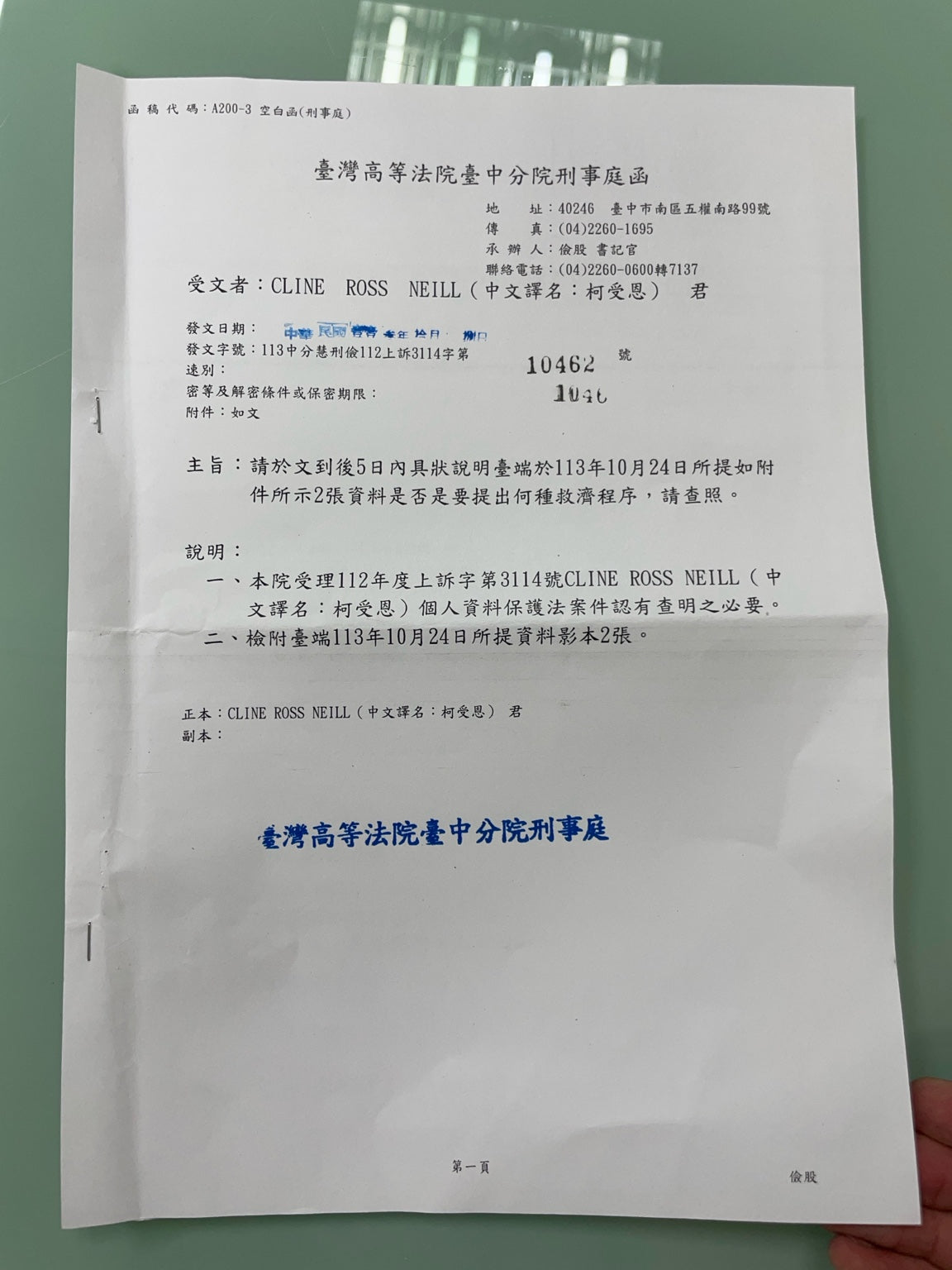
- Legal Mail — October 17, 2024 (TDPO 2)
- Taichung District Prosecutors Office (3)
- Taichung District Prosecutors Office (Master)
- Legal Mail — October 22, 2024
- Legal Mail — October 28, 2024
- Legal Mail — November 1, 2024
- Mail — November 2024 (image 1)
- Mail — November 2024 (image 2)
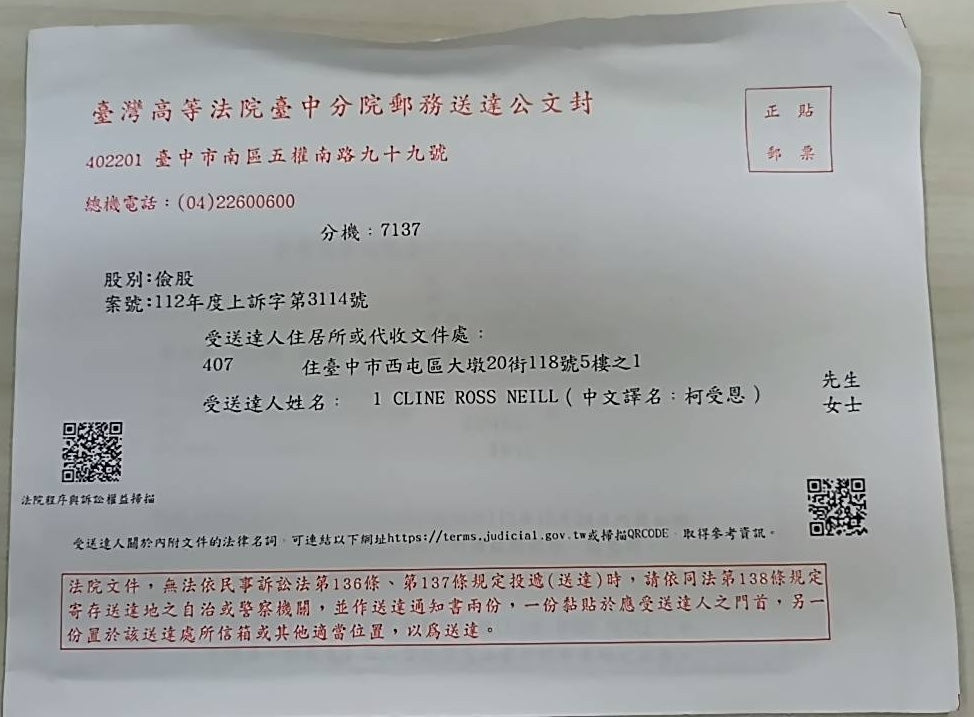
- Envelope — November 2024 (image)
- Legal Mail — November 28, 2024
- Legal Mail — November 28, 2024 (copy)
- Legal Mail — December 5, 2024
- Legal Mail — December 5, 2024 (2)
- Legal Mail — May 27, 2024 (filename variant)
- Legal Mail — May 10, 2024 (alt set)
- Legal Mail — May 10, 2024
2025
Miscellaneous / Undated
- Accountant since 2009 — dropping me as a client
- Application for an Acquittal
- GAC and Ross Cline
- Re: GAC and Ross Cline — follow-up (mail outage)
- Legal Aid Foundation — Taichung Branch (Main)
- Legal Aid Rejection — August 23, 2024
- National Taichung University of Science & Technology
- RESEAU_DE
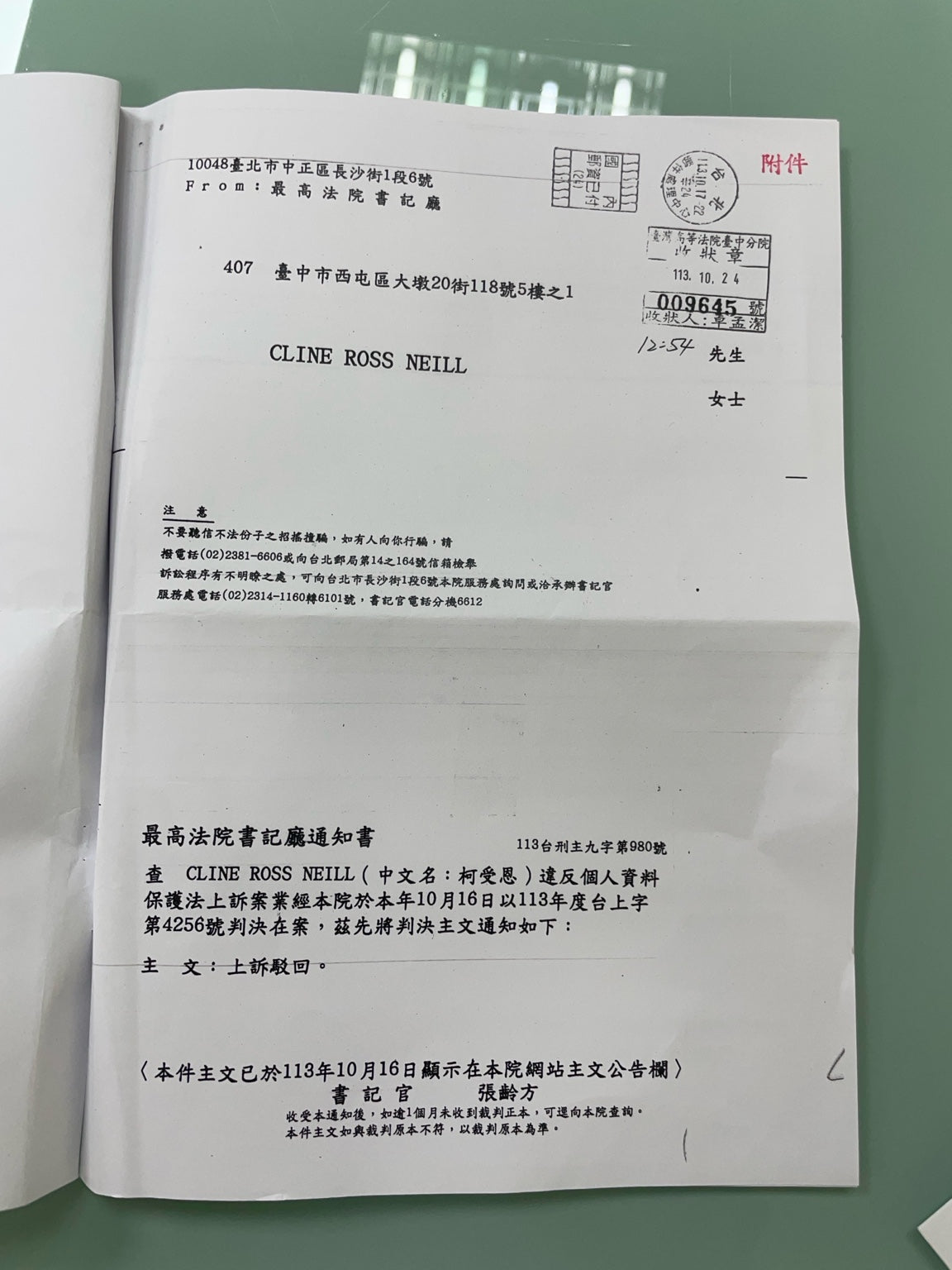
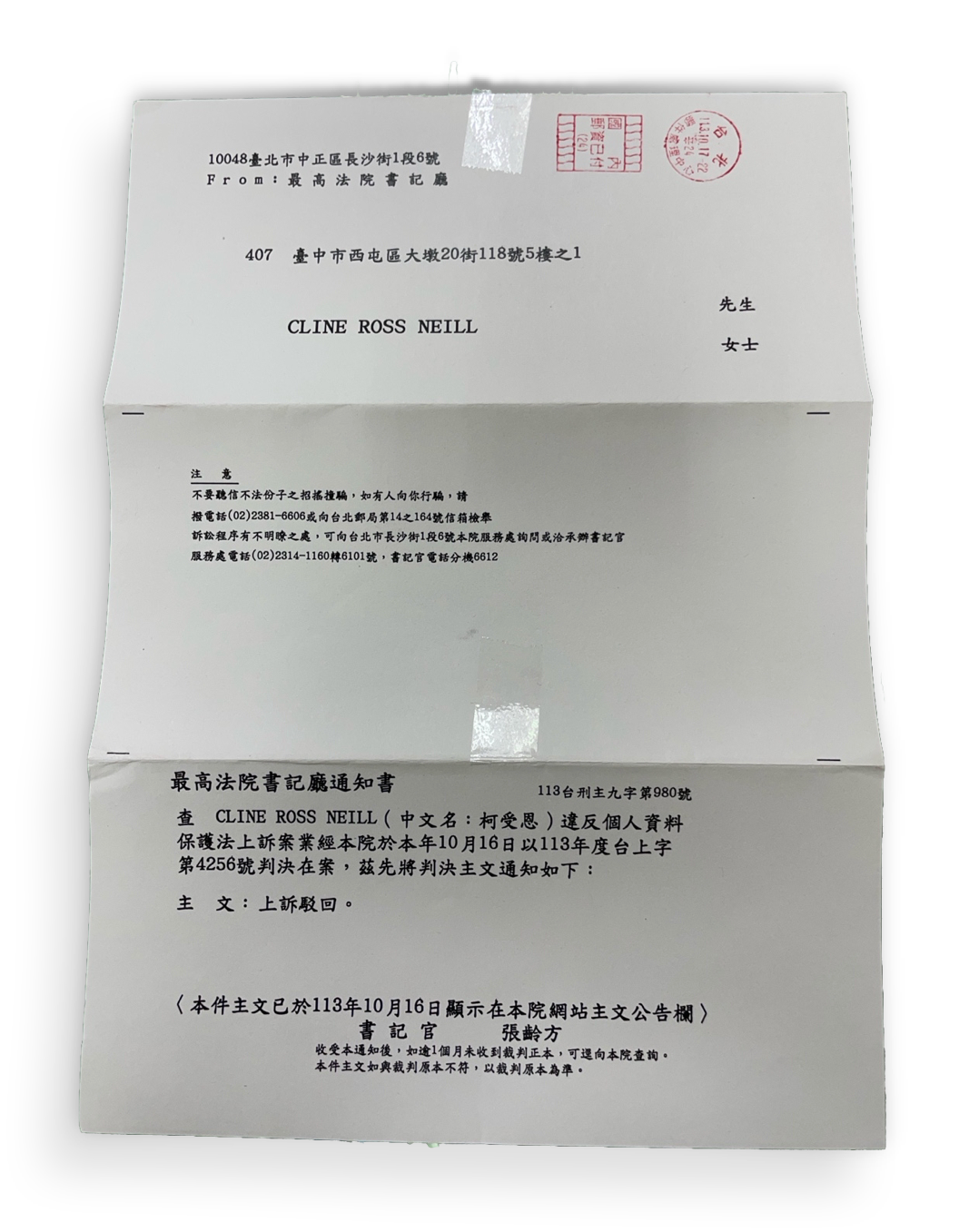
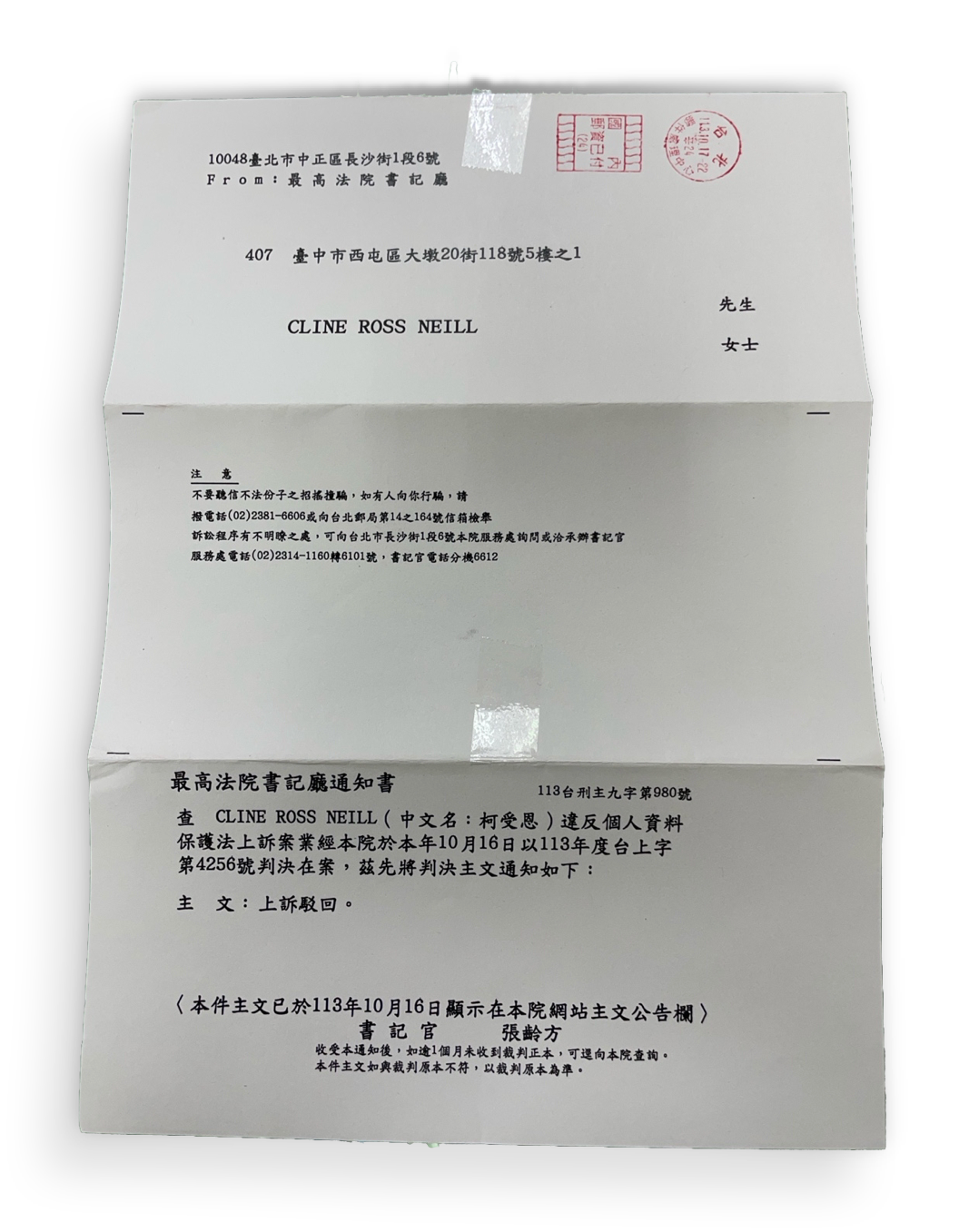
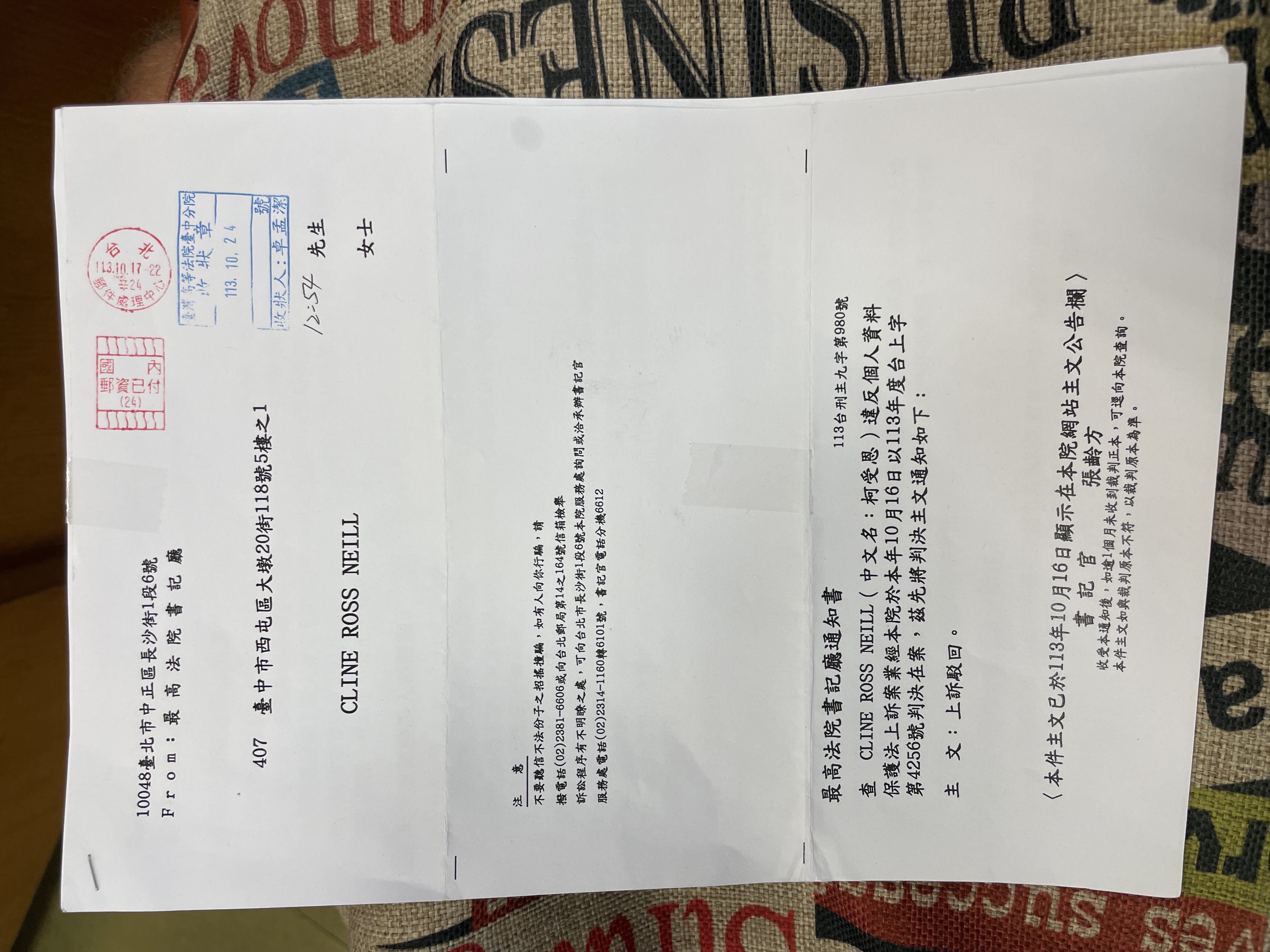
- Taiwan Supreme Court — Final Notice (image)
- Tenancy Agreement
- Taiwanese Administrative / Contact Record
- Letter (image)
- Proof of 4th Appeal (image)
- Full Statement
- Timeline
- Urgent Case Submission — Prosecutorial Contradiction / Due Process Failure
- Write to the President (image)
- Letter to Legal Aid
Key Evidence — Start Here
Audio Recordings — Taiwan Landlord Scam Case
Legal & Ethical Note: These recordings and documents are shared in the public interest — to document inconsistencies, procedural concerns, and due-process failures described in the official record. Every effort has been made to present the material accurately and without alteration. Personal data unrelated to the case has been withheld wherever possible. This publication is not intended to harass, defame, or endanger anyone; it is an act of documentation following years of petitions and requests for review. The material was recorded during proceedings in which I was a direct participant and is published from outside Taiwan under protections for freedom of expression and public-interest reporting.
 Each entry below includes a short context note, a playable audio file, and a direct download link for archiving and transparency.
I’m publishing this material because I still care deeply about Taiwan and because I believe the documentary record matters — especially when formal channels have produced little acknowledgement or correction.
One moment that captures the tone of this experience: during a High Court visit, clerks required me — a foreigner with limited written Chinese — to complete handwritten text that I could not reasonably verify for accuracy. Whether this was indifference or something worse, it was degrading. Incidents like that are difficult to convey without recordings and documents.
What is shared here is only a portion of the record. Additional documentation may be published as the record develops, in the same documentary format.
Taiwan Taichung District Court — August 14, 2023
This recording documents a hearing at the Taichung District Court on August 14, 2023.
The session repeatedly returns to one question: “Why did you post the rental contract, Mr. Cline?” The focus remained fixed on the posting itself, rather than the context surrounding it — including the alleged contract breach that prompted the posting and the safety concerns I raised at the time.
In the recording, I explain that a key term of the contract (including the rolling metal gate / security situation) was not being addressed, and that I posted the contract to document the dispute after mediation attempts were unsuccessful. I also reference a threatening call attributed to the landlord’s husband, and how that threat was treated as peripheral rather than central to my safety and state of mind.
To my ear, this hearing captures a recurring pattern: narrow procedural framing, limited engagement with context, and an apparent unwillingness to weigh competing evidence in a way that a foreign defendant could meaningfully understand and respond to.
This audio may sound repetitive, but it reflects how the same issue was revisited across years — and how context was repeatedly minimized.
Conversation with Lawyer — September 28, 2023
This recording captures a long conversation between me and a Taiwanese lawyer on September 28, 2023.
I contacted this lawyer hoping to hire private counsel to review the record independently. In the conversation, he explains practical and professional constraints around taking a case that had already involved Legal Aid, and he recommends pursuing a different Legal Aid lawyer rather than switching to private representation.
For me, this call illustrates a structural problem I encountered repeatedly: even when I was prepared to pay for outside review, the pathway to meaningful independent legal assistance felt limited and uncertain.
Listening back, it’s clear I was exhausted but still asking the same basic thing: for someone to look at the documentary record carefully, including procedural issues and apparent inconsistencies.
Me Suing Bella — November 14, 2023
This recording captures a court appearance connected to my attempt to pursue a fraud-related complaint against my former landlord (referred to here as “Bella”).
At that stage, I was unrepresented and navigating procedural requirements without meaningful language support. My aim was straightforward: to ask the court to examine the underlying dispute, including the circumstances that led to the contract being posted and the alleged threats that were reported.
In the recording, you can hear the process shift toward forms, technical requirements, and procedural thresholds rather than an evaluation of the core issues. For me, this was one of the moments where it became difficult to believe the system was designed to provide an effective remedy to a foreign complainant on equal footing.
This is not a “dramatic” recording — but it is part of the paper-and-audio trail that shows how the dispute expanded over time while meaningful resolution remained out of reach.
Call from Immigration in Taiwan — November 23, 2023
This recording captures a call from Taiwan’s immigration office on November 23, 2023.
When immigration contacts a foreign resident, it carries obvious pressure. In this call, my concern is clear: I had lived in Taiwan for many years, registered properly, and operated a legitimate business. Yet the tone and substance of the call reinforced the feeling that I was being treated as a case file rather than a person facing escalating legal jeopardy.
In context, this recording matters because immigration contact and criminal proceedings can intersect in ways that heighten vulnerability for non-citizens — especially when language barriers and procedural complexity are already present.
March 27, 2024 — Court Date (Settlement Discussion)
This recording (about 17 minutes) documents a hearing in which the court again raised settlement.
There were translators present and the tone is procedurally polite. However, the substance highlights a recurring problem: settlement is not a meaningful option when one party’s position is not a compromise but an all-or-nothing demand.
This clip is useful as a simple illustration of how the process repeatedly returned to settlement prompts without resolving the underlying impasse.
April 8, 2024 — Court Call and Negotiation Question
This recording captures a call from a court clerk on April 8, 2024, relaying the judge’s repeated request that I “negotiate” with the landlord.
In the call, I explain that negotiation had repeatedly failed and that the landlord’s demands were not realistically payable. The call also illustrates a procedural confusion I experienced often: multiple hearing dates were scheduled close together, yet the explanation for what each hearing was for was unclear to me.
This matters because when a defendant cannot reliably understand scheduling, purpose, or procedural posture — especially across a language barrier — meaningful participation becomes extremely difficult.
Court Voicemail — April 17, 2024
This short recording (just over two minutes) is a voicemail from the Taichung High Court on April 17, 2024.
The caller asks whether I am willing to mediate with the other party. In context, the message shows how the system continued to encourage mediation even after prolonged conflict and repeated failures to reach any workable terms.
For readers, this voicemail is a small but telling artifact: polite language and procedural routine overlaying a dispute that had already escalated into severe personal and legal consequences.
Courthouse Audio — April 17, 2024
This recording (about 1 hour and 55 minutes) captures a long hearing day in court.
A significant portion returns to the same core framing: the posting of the contract, rather than the reasons for it, the surrounding dispute, or the evidentiary and procedural issues that I repeatedly raised.
I describe the repair attempts that left conditions worse, and I explain why documentation became my only reliable method of communicating factual context in a system where written Chinese dominated the record.
Even where the hearing sounds slow, it remains part of the documentary record of how the case functioned in practice — and why it became impossible for me to believe I was receiving a fair assessment on equal terms.
May 16, 2024 — Court Date (Context for the Audio Recording)
This recording corresponds to my court appearance on May 16, 2024 — one of multiple proceedings tied to the same underlying allegation.
In the recording and surrounding record, I repeatedly raised procedural concerns: that matters connected to the same brief posting were pursued across separate tracks; that language barriers materially affected my ability to respond; and that exculpatory context was not being weighed in a way that felt coherent or fair.
I also describe how key details — including the identity of the person associated with a threatening call — were documented in Chinese in a way I could not meaningfully verify at the time. This is one of the clearest examples of how language access affects due process in real life, not in theory.
It is also worth noting the presence of a court interpreter who treated the situation with professionalism and kindness. Individuals can act with integrity even when a process as a whole feels broken.
In Court — June 18, 2024
This recording comes from my court appearance on June 18, 2024.
Again, the process appears to narrow its focus to the posting of the contract rather than a full, contextual evaluation — including witness testimony that I believe was important, and the state of mind in which I acted.
The recording also shows the contrast between individual professionalism (including interpretation support) and a broader pattern of procedural decisions that, in my view, undermined fairness.
For observers, this hearing is not significant because of a single “moment,” but because it mirrors what happened across years: repetition of a narrow allegation, and a persistent minimization of contextual evidence.
Call with Mr. Huang — October 22, 2024
This recording relates to my call with Mr. Huang after I received a Supreme Court-related notice that, as delivered, raised basic questions about formality and secure communication.
In the call and its surrounding context, the key issue is not paperwork alone — it is the larger concern that the process had become rigid, formalistic, and disconnected from the real-world consequences for a foreign defendant.
I include this recording because it reflects what I encountered repeatedly: communication that assumes fluency, assumes legal literacy, and assumes equal access to remedies — assumptions that do not match the lived experience of many foreigners navigating Taiwan’s legal system.
February 19, 2025 — Immigration Call
This recording was made on the evening of February 19, 2025, while I was in New Brunswick, Canada, when I received an unexpected call from Taiwan’s immigration office.
In the call, the officer discusses options associated with community labor versus incarceration. I explain why those options did not feel like meaningful alternatives given my position: the underlying dispute, the procedural history, and the serious consequences already imposed.
This matters because it shows how immigration contact can follow a defendant across borders — and how the system’s expectations can remain unchanged even when new official correspondence later acknowledges mitigating facts.
It is one more piece of the record illustrating why I believe the outcome in this case is disproportionate to the underlying conduct — and why I am asking for independent review and rectification.


.jpg)